Goo-jz-ia
How Ghouzja started
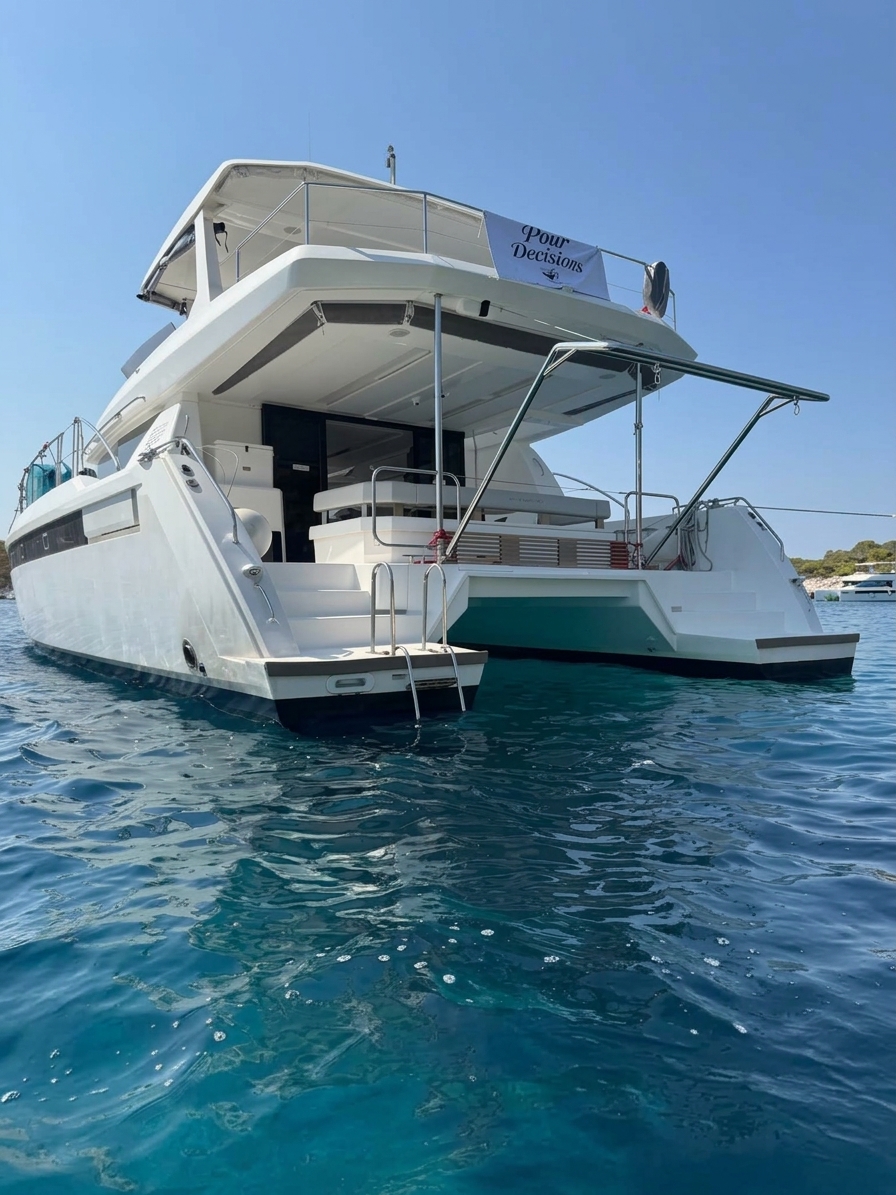
September 2026. Eight friends on a 48-foot catamaran in Croatia. Island to island, no itinerary worth mentioning: eat well, drink early, swim when the water looked too good to refuse, and spend a week in the same place at the same time. Life usually scatters people. For seven days the machinery stopped. Boat beneath us, Adriatic ahead of us, almost no interest in what time it was.
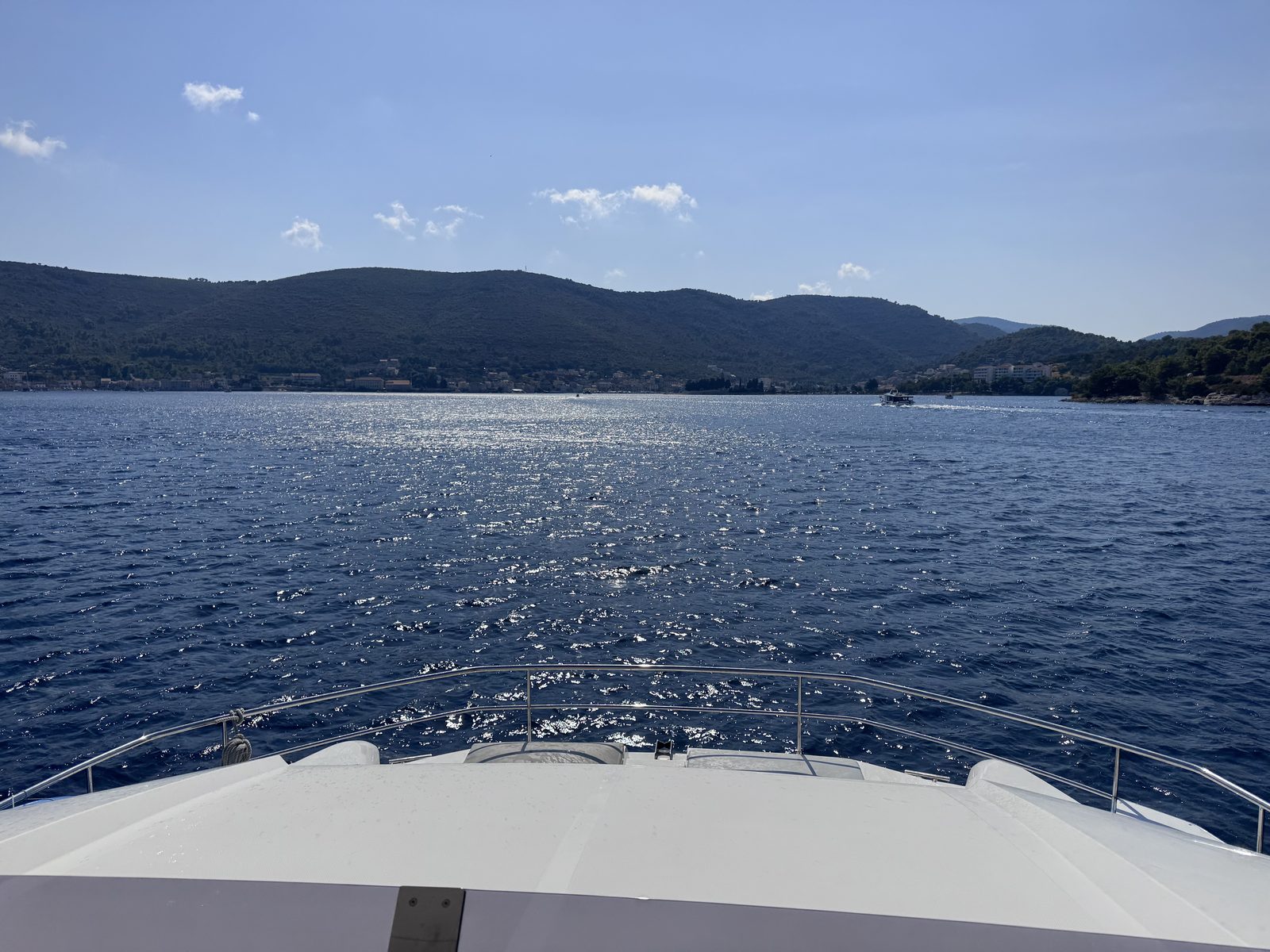
The coast had no interest in subtlety: limestone, pine, old stone towns around little harbors, water so blue it looked fake. Mornings we left one harbor and pointed at another. Someone took the wheel, someone made coffee, and the Sarti Spritz and wine appeared long before late afternoon. Croatia had abolished that rule. Offshore the world shrank to the boat, the horizon, and whoever was standing nearby. The catamaran answered heavy and smooth, the bow lifting, two white trails dying behind us.
We’d find a cove, drop the anchor, listen to the chain thunder through the bow. Engines off. Swim. Salt, sun, wet footprints, nobody in a hurry. Then bread, cheese, aromatic sausage, olives, fruit — an unreasonable amount of cheese that felt completely reasonable. The upper deck was the gathering place at every hour. White wine sweating in the hand before lunch, later a beer, then red as the sky went silver, gold, copper, deep blue. Another story. Another reason not to go to bed.
Ashore: narrow streets, little shops, pastry shops, gelato in colors not generally found in nature, and dogs who clearly believed they had booked the trip. We ate peka under an iron bell, drank wines we could barely pronounce, and walked with no destination. Somewhere on one of those streets, after a few cocktails, came the moment everything else followed.
The First Ghouzja.
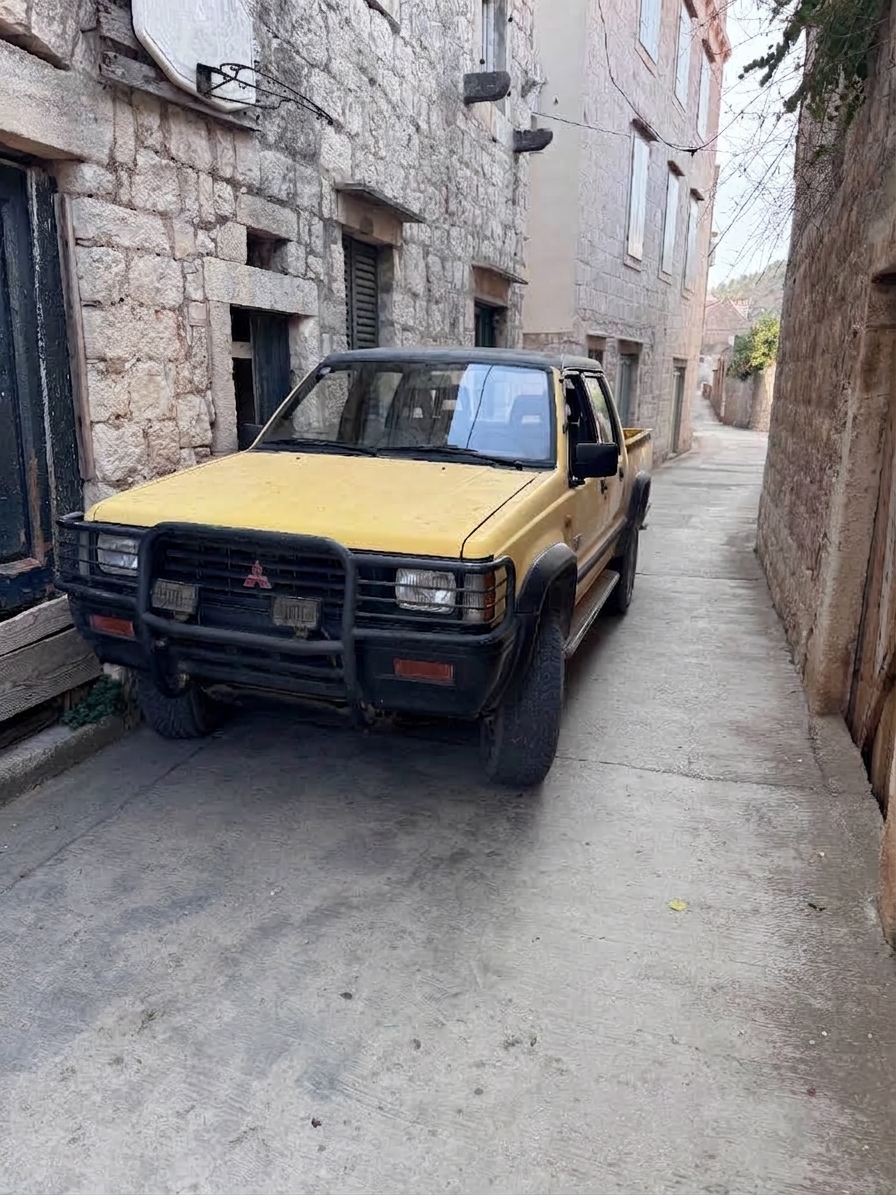
There was nothing remarkable about the setting at the time. We were simply walking together down this street, after a few cocktails, talking, laughing, and greeting people as we passed. Stone walls close enough to touch. A yellow truck filling half the lane, as if it had always been parked at the beginning of the story. Someone would smile. Someone would nod. Maybe a shopkeeper stood in a doorway or another traveler passed us. The ordinary little encounters that happen when you are wandering through an unfamiliar place and feeling particularly pleased with the world.
Normally, one of us would have said hello.
Instead, spontaneously and for no reason that could possibly be reconstructed later, one of us looked at another human being and said:
“Ghouzja.”
And there it was.
The first one.
Before that instant, as far as anyone knows, Ghouzja had never existed.
There had been thousands of years of language. Civilizations had risen and fallen. Empires had crossed the Adriatic. Romans, Venetians, Croatians, merchants, sailors, soldiers and tourists had walked those same stone streets, presumably managing perfectly well with the words already available to them.
Then we came along.
And someone said Ghouzja.
The recipient of this historic event had no idea what had just happened. To be fair, neither did we.
There was no pause to admire the significance of the moment. No one announced that a new word had just entered the world. It simply sounded funny.
So we did the only reasonable thing.
We said it again.
Another person passed.
“Ghouzja.”
A smile.
Someone else approached.
“Ghouzja.”
A nod.
Then another.
“Ghouzja!”
Now it was becoming a thing.
Someone asked what language that was. We said, as if it had always been obvious: Ghouzja Language!!!
That first Ghouzja had opened a door, and apparently none of us had any intention of closing it.
At first, the word existed only as our increasingly ridiculous substitute for hello. It was not Croatian. It was not English. It was not anything. It simply had a sound we liked: vaguely foreign, slightly sophisticated, faintly indecent, and enormously satisfying to say.
By the time we returned to the boat, Ghouzja had come aboard with us.
You walked onto the upper deck and instead of saying good morning, you said Ghouzja. Someone handed you a glass: Ghouzja. Someone climbed dripping from the Adriatic: Ghouzja. Someone appeared from below deck looking slightly worse than they had the night before: definitely Ghouzja.
Then the word began to misbehave.
Someone’s toe hurt.
“My Ghouzja hurts.”
Nobody asked what that meant. Somehow everyone knew exactly what it meant.
“My Ghouzja is sore.”
“Don’t touch my Ghouzja.”
Entirely reasonable statements.
That was the first sign that Ghouzja had ambitions beyond greeting people.
Soon it became an emotional condition. “I’m feeling a little Ghouzja today.” Then it became descriptive. “That’s very Ghouzja.” A person could be Ghouzja. An evening could become Ghouzja. A questionable decision, especially one made after several glasses of wine, could reveal itself the next morning to have been profoundly Ghouzja.
The word slipped effortlessly into every available grammatical space. It could be a noun, an adjective, a verb, a greeting, a warning, a complaint, a diagnosis, an insult, a compliment, an anatomical structure, an emotional state, or a general assessment of circumstances. It could describe a person, a place, an injury, a mood, a night, or something that had gone very wrong and was somehow still funny.
The remarkable thing was that the more meanings we gave it, the less explanation it required. A soft “Ghouzja” across a table could mean one thing. A loud “GHOUZJA!” from the upper deck meant something entirely different. A long, drawn-out “Ghouuuuzja…” usually indicated that someone had made a decision whose wisdom had not survived the passage of time. A quiet Ghouzja accompanied by a raised eyebrow could communicate an entire paragraph.
The word began behaving as though it had rules even though none of us had written them.
That was when the myth began.
Not because there was any mystery about where Ghouzja came from. We knew exactly where it came from. It began on a narrow Croatian street at the precise moment one perfectly serviceable “hello” was discarded in favor of something that had never existed before.
The mythology came afterward.
We had invented a meaningless word, and somehow it refused to remain meaningless. Every use gave it another shade. Every joke added another layer. Every day gave it another job. Ghouzja was no longer simply replacing hello; it was absorbing whatever we needed it to mean. And because nobody had ever defined it, nobody could use it incorrectly.
That was the genius of Ghouzja.
Ordinary words arrive with baggage. Definitions, histories, spellings, grammatical rules, and people eager to tell you when you are using them incorrectly. Ghouzja had none of that. It was linguistic anarchy with excellent timing.
It also fit the week perfectly. Nothing about those days felt especially serious. We were not trying to accomplish anything. There was no milestone, no achievement, no grand event to point to afterward. It was simply eight friends together on a boat, moving through beautiful water, laughing more than usual, eating too much, drinking early and often, and briefly stepping outside the routines that normally defined our lives.
Ghouzja became the private language of that little world.
By the final days, it followed us everywhere. Onto the dinghy. Into restaurants. Through villages. Back onto the boat. Across dinner tables. Up to the upper deck. It attached itself to stories, jokes, minor injuries, questionable decisions, people who had no idea they had just been classified as Ghouzja, and moments for which normal vocabulary suddenly seemed inadequate.
There were good days, and then there were Ghouzja days. There were bad decisions, and then there were Ghouzja decisions. There were funny stories, and then there were stories that could only be described as Ghouzja.
Somewhere along the way, the joke became tradition.
Then the week ended.
The boat had to be returned. Cabins were emptied, bags appeared, clothes were pulled from corners, and half-finished bottles were examined with the solemnity they deserved. The anchor came up one last time and we headed toward the marina. The coastline was still beautiful and the water was still blue, but now there were flights to catch, homes to return to, and ordinary life waiting patiently for all eight of us.
Ghouzja should have stayed there. It should have remained one of those ridiculous vacation jokes that makes perfect sense while everyone is together and then quietly dies when the trip is over.
But it didn’t.
It came home with us.
And now, whenever one of us says it, everything behind that first Ghouzja comes rushing back: the boat, the Adriatic, the narrow streets, the morning Sarti Spritz, the wine, the ridiculous dogs, the cheese, the laughter, and eight good friends who had been handed a brief stretch of time together and knew enough to enjoy it.
The entire mythology traces back to one tiny moment. A stranger passed. One of us should have said hello.
Instead, for the first time in recorded history, someone said:
Ghouzja.
And in the end, it is Ghouzja.